
Saturday, April 21, 2012


Tuesday, August 2, 2011
Low-carb, high-fat diets add no arterial health risks to obese
Good news, I would say:
Low-carb dieters showed no harmful vascular changes but also on average dropped 10 pounds in 45 days, compared to an equal number of study participants randomly assigned to a low-fat diet. The low-fat group, whose diets consisted of no more than 30 percent from fat and 55 percent from carbs, took on average 70 days, nearly a month longer, to lose the same amount of weight. [...]
However, Stewart does contend that an overemphasis on low-fat diets has likely contributed to the obesity epidemic in the United States by encouraging an overconsumption of foods high in carbohydrates. He says that high-carb foods are, in general, less filling and that people tend to get carried away with how much low-fat food they can eat. More than half of American adults are estimated to be overweight, with a body mass index of 26 or higher; a third are considered to be obese, with a BMI of 30 or higher.Full article here.
Monday, August 1, 2011
Vitamin C
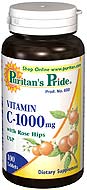 I use the Puritan's Pride vitamins and other food supplements daily and I recommend them anybody. The quality of the products is good and relatively cheap on the market.
Let's start my list with Vitamin C. I just checked out The Vitamin C Foundation website and I read this:
Comment: I had been taking 1000mg of vitamin C. When I increased to 3000 mg, my BACK problems disappeared.
I think if you take only the RDA minimum of Vitamin C 60 mg each day it is not enough for your body's proper operation. I took at least 1000 mg C daily, but I'm healthy if you have any disease or disorder you should take much more.
I take at least one tablet of Natural C Vitamin with Rose Hips 1000 mg daily.
Puritan's has a wide selection of Vitamin C 250 mg-1500 mg and 100 tablets to 1000 tablets. They have Normal or Time Release C, ESTER-C and crystals as well.
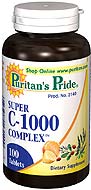
And there is a Super C Complex with Citrus Bioflavonoid, Rutin, Hesperidin, Acerola. The Vitamin C is better if you take with these flavonoid elements.
Puritan's currently have a sale on supplements if you buy 1 get 1 free or buy 2 get 3 free total 5 bottles.
The shipping to US is only $ 3,95 on any size order.
Omega 3 Fish Oils
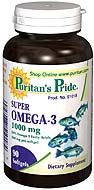 I take Fish Oil product daily specially the Super Omega-3 1000 mg soft gel like on the picture left.
This Cholesterol Free Omega-3 Fish Oil contains EPA and DHA, two fatty acids that help support and maintain the health of your cardiovascular system.
Omega-3 fatty acids are considered one of the “good” fats important for cellular, heart and metabolic healthand may also help support joint health.. This product comes in a larger dosage size to ensure you are getting all of the benefits fish oil is famous for providing.
Additionally, fish oil also helps maintain triglyceride levels already within a normal range. Most of the people doesn't eat enough fish or sea products daily. So they can't take enough Omega 3 fatty acids with their meal but it's important.
Fortunately I'm healthy and I want to stay healthy.
Hair care - Oliva Shampoo
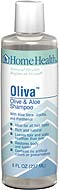
I've tried this Oliva Shampoo some months ago and this is a good product, not like casual shampoos from the store. It's gently cleanses my hair and my scalp. I use this shampoo because rich in natural ingredients like Olive Oil, vegetable protein, Aloe Vera, Jojoba.
I'm a boy and don't have to use conditioner but I think the conditioner should be as good as the shampoo is.
Vitamin B 12
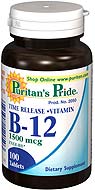 Vitamin B12 is also called cobalamin because it contains the metal cobalt. This vitamin helps maintain healthy nerve cells and red blood cells and gives more energy.
Vitamin B12 is bound to the protein in food. Hydrochloric acid in the stomach releases B12 from proteins in foods during digestion.
Vitamin B12 is naturally found in animal foods including fish, meat, poultry, eggs, milk, and milk products. Fortified breakfast cereals are a particularly valuable source of vitamin B12 for vegetarians.
Plantarian health NewYearHealth Challenge
Plantarian Healthy Double One Diet Challenge:
A 11 day challenge to eat more healthily and sustainably starting on 1:11:11 www.1worldday.org
A 11 day challenge to eat more healthily and sustainably starting on 1:11:11 www.1worldday.org
 | |||||||||||||||||||||||||
| New World Record attempt for health and sustainability at www.1worldday.org |
Fat burners and Diet Products
I recommend these Diet products instead of regular Fat Burner tablets.
 You've heard of the latest diet phenomenon, the Cabbage Soup Diet. Now Puritan's Pride is offering the Seven Day Souper Cabbage Diet, a supplement that combines many of the basic ingredients found in this diet. 7 DAY SOUPER CABBAGE DIET SYSTEM Caplets contain naturally-occurring flavonoids, lycopene, carotenoids, polyacetylenes, sulforaphanes and indole 3 carbinol to boost the phytochemical content of the diet.
Also included is a diet plan PLUS exercise program to help you get on the fast track to help you achieve your weight loss goals

Fiber Diet tablets are a special combination of grain and fruit fiber. To add healthful fiber to your diet take Fiber Diet tablets 15-30 minutes before you eat. Each tablet is free of sugar, starch, preservatives and artificial colors. There is no caffeine or sodium (salt).
This special fiber supplement comes with helpful tips on how you can make a reduced calorie diet a more enjoyable experience.
Important note: If you're on diet you need to take other supplements like Vitamin-C, B-Complex, Calcium-Magnesium, and Spirulina algae. I take all these supplements daily.
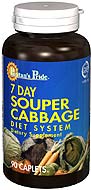 You've heard of the latest diet phenomenon, the Cabbage Soup Diet. Now Puritan's Pride is offering the Seven Day Souper Cabbage Diet, a supplement that combines many of the basic ingredients found in this diet. 7 DAY SOUPER CABBAGE DIET SYSTEM Caplets contain naturally-occurring flavonoids, lycopene, carotenoids, polyacetylenes, sulforaphanes and indole 3 carbinol to boost the phytochemical content of the diet.
Also included is a diet plan PLUS exercise program to help you get on the fast track to help you achieve your weight loss goals
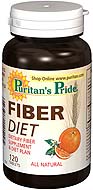
Fiber Diet tablets are a special combination of grain and fruit fiber. To add healthful fiber to your diet take Fiber Diet tablets 15-30 minutes before you eat. Each tablet is free of sugar, starch, preservatives and artificial colors. There is no caffeine or sodium (salt).
This special fiber supplement comes with helpful tips on how you can make a reduced calorie diet a more enjoyable experience.
Important note: If you're on diet you need to take other supplements like Vitamin-C, B-Complex, Calcium-Magnesium, and Spirulina algae. I take all these supplements daily.
FDA Diabetes Actos (pioglitazone) Cancer Risk

The U.S. Food and Drug Administration today announced it has begun a safety review of the diabetes drug Actos (pioglitazone), after receiving preliminary results from a long-term observational study designed to evaluate the risk of bladder cancer associated with use of this drug.
The preliminary results are based on five-year data from an ongoing, 10-year observational study by the manufacturer, Takeda Pharmaceuticals North America Inc., San Diego. These early results showed no overall association between Actos exposure and risk of bladder cancer. However, there was an increased risk of bladder cancer in patients with the longest exposure to Actos and in those with the highest cumulative dose of the drug.
Despite this The agency has not concluded that Actos increases the risk of bladder cancer.
Meanwhile a group of Doctors in America have researched a drug free, free of dangerous side effects , way of tackling the Diabetes epidemic now the scourge of the Western World - eat real food! Physicians Committee for Responsible Medicine PCRM are gathering information from ongoing research that shows a Plantarian Diet can have a dramatic effect on type 2 (and in some cases type 1) diabetes.
This is pretty much the same diet used by President Bill Clinton to lose weight and deal with his heart disease.
The Diet does come with a health warning ! The effects are so dramatic that you have to carefully watch your medication and be prepared to reduce the dose otherwise you may have an overdose.
The Food for Life Alliance has recently trained instructors in the diet principles and will soon be conducting a number of free workshops around the UK starting with Stoke , Birmingham and London.
New Study: 22% less Heart Disease risk

Published today in the European Heart Journal
Data analysed from the European Prospective Investigation into Cancer and Nutrition (EPIC) Heart study has shown that people who ate at least eight portions of fruit and vegetables a day had a 22% lower risk of dying from IHD than did those who consumed fewer than three portions a day.
This study involved over 300,000 people in eight different European countries, with 1,636 deaths from IHD.
Professor Sir Michael Marmot, director of the University College London (UCL) International Institute for Society and Health, head of the UCL Department of Epidemiology and Public Health, and chairman of the Commission on Social Determinants of Health, writes separately “Such an odds ratio is of huge practical importance. Cardiovascular disease is the most common cause of death. A reduction of 22% is huge. But... this reduction in mortality comes with consumption of eight portions a day, or 640g. Such a high consumption was found in only 18% of the men and women in these eight cohorts. There would need to be big shift in dietary patterns to achieve this healthy consumption of eight portions a day. It is worth trying to move in that direction. Reductions in cancers of several sites, in blood pressure and stroke, would add to this reduction in fatal CHD. Moving to a diet that emphasises fruit and vegetables is of great importance to public health.”
ONE WORLD DAY - A Day of Health & Sustainability

One World Day - Plantarian - The road to sustainability and health
Plantarians have taken the healthiest and most sustainable bits of vegetarian and veganism to clear a simple pathway through the jungle to a lifestyle of optimum health and sustainability. 'Harmony and Harmlessness' says 1worldday.org
B-Vitamins and B-Complex
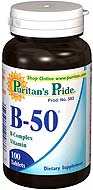 I take daily one tablet B-Complex 50 mg tablet, one B1 250 mg tablet and one B-3 Vitamin (Niacin) 100 mg tablet.
The Vitamins B works better if they are together B1, B2, B3, B6, B12, PABA, Coline, Inositol, etc. And if you take only B1 or B6 you'll have a deficit from the other Bs. So always take B Complex!
If you take Vitamin Bs, B-Complex you have to take Calcium and Magnesium. B1 reduce the Calcium level in your body specially in bones.
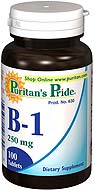 Vitamin B1 is a water-soluble vitamin needed to process carbohydrates, fat, and protein. Every cell of the body requires vitamin B1 to form the fuel the body runs on—adenosine triphosphate (ATP). Nerve cells require vitamin B1 in order to function normally.
My experience: Vitamin B1 is a very goodtranquilizerr much better than drugs from pharmacy. Take two 250 mg tablets of B1.
If you have some hard drink take B1 and you're notgoingg to be drunk. Drugs and alcohol burn all of the B1 in your body and this is the why you feel so.
 Niacin is part of a coenzyme needed for energy metabolism, and it helps maintain healthy functions of the nervous system, digestive system and skin.
Not Niacinamide because Niacinamide is not as useful as Niacin.
I know if you take B-3 Niacin you'll have a flush. But it is not a problem at all. It happens because the real niacin start to purify your body. Actually there are a lot of toxin in your body mainly in body fat and the flush occur because these elements getting out.
I did a very good Purification Program and this program based on NIACIN. If you want more information about it buy the Clear Body Clear Mind book by L. Ron Hubbard, it explains in detail the whole program.
Cod Liver Oil
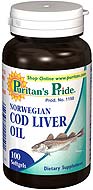 Norwegian cod has traditionally been one of the most popular natural sources of Vitamins A & D. Vitamins A and D help maintain bones, as well as a healthy immune system.
Vitamin A assists in many other functions such as eyesight and skin maintenance.
Oil from fish contains omega-3 fatty acids. The omega-3 fatty acids in fish oil help to balance the omega-6 fatty acids, which are found mostly in vegetable oils.
Men's Health Products
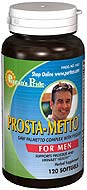 I use vitamins and other food supplements daily and I recommend some special products specially for Men.
Prevent or cure prostate problems
The high-quality PROSTA-METTO formula is an excellent choice for men who are interested in supporting their prostate and urinary health. This supplement contains our Saw Palmetto Complex Blend, which includes 80 mg of Saw Palmetto Extract, the leading herb for men'’s health, especially in later years. Saw Palmetto contains phytochemicals, which support prostate and urinary health in men. It also contains 10 mg Pygeum Africanum Extract for prostate support, 5 mg Uva-Ursi for fluid balance, and 40 mg Pumpkin Seed Oil Extract. Men can take one softgel four times daily. The Ultra Man™ 75 is specially tailored to meet the nutritional requirements of men everywhere. It contains important vitamins that contribute to immune, cardiovascular and nervous system health, as well as healthy bones and teeth. The B vitamins in this formula support energy metabolism, and antioxidant vitamins like Vitamins C, Beta-Carotene and Alpha Lipoic Acid fight cell damaging free radicals. The essential mineral Zinc is included to help promote male reproductive health and Lutein is added for eye health. Additional factors traditionally considered beneficial to men include Lycopene, Saw Palmetto, Vitamin E and amino acids.
 Yohimbe is for Man's Sexual Health instead of Viagra. I don't recommend to take Viagra or other drugs for your sexual health but the choice is up to you.
Discover the exotic flavor of the African jungle with Yohimbe Bark. Derived from an African evergreen tree, Yohimbe was used by warriors preparing for battle and young males as part of their marriage ritual. The sensual properties of this mystical extract stimulate the animal prowess in every man. Yohimbe Bark is perfect for those long romantic nights of passion.
Coral Calcium
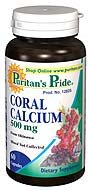 Coral Calcium mineral products are very popular calcium dietary supplements nowadays.
Coral Calcium promotes bone strength and supports heart, nerve and muscle functions. Puritan's Coral Calcium is mined, not collected, from an above ground source located in Okinawa, Japan, making it environmentally friendly.
500 mg bioavailable calcium per serving with 72 trace minerals.
Coral calcium
Heart Health in Vegans and Vegetarians

The review summarizes the effect of a habitual vegetarian diet on clinical complications in relation to chemistry and biochemistry. Omnivores have a significantly higher cluster of cardiovascular risk factors compared with vegetarians, including increased body mass index, waist to hip ratio, blood pressure, plasma total cholesterol (TC) triacylglycerol and LDL-C levels, serum lipoprotein(a) concentration, plasma factor VII activity, ratios of TC/HDL-C, LDL-C/HDL-C and TAG/HDL-C, and serum ferritin levels.
However in the review, compared with omnivores, vegetarians, especially vegans, have lower serum vitamin B(12) concentration and n-3 polyunsaturated fatty acid (PUFA) levels in the tissue membrane phospholipids, which are associated with increased collagen and ADP stimulated ex vivo whole blood platelet aggregation, plasma 11-dehydrothromboxane B(2), and homocysteine levels and decreased plasma HDL-C.Increased homocysteine and imbalances in HDL / LDL and omega 6 and 3 levels are factors in meat eaters that are associated with an increased thrombotic and atherosclerotic risk.
The author suggested that vegetarians, especially vegans, should increase their dietary n-3 PUFA and vitamin B(12) intakes.
Leading UK Nutritionist Yvonne Bishop-Weston from Foods for Life Health and Nutrition Consultancy says "This review will bolster the argument that vegetarian and vegan diets don't grant you automatic immunity from heart disease. Some would deem it pedantic, but to get the full health benefits of vegetarian and veganism one needs to follow a predominantly Plantarian diet based on natural, wholefood plant based principles rich in a natural synergy of vitamins, minerals, anti-oxidants, fibre and essential fats."
"With recent increased availability of vegan sources of omega 3 fats in echium oil and algae there is no need for vegans, vegetarians and plantarians to miss out on high levels of essential fats and these plant based fats have the advantage of avoiding the complications of toxicity, un-sustainability and undesirable saturated fats in fish oil. Chorella is a potential source of vitamin B12 for vegans" she adds.
* Chemistry behind Vegetarianism. Li D Department of Food Science and Nutrition, Zhejiang University, China
Fasting insulin and weight loss and calories-in vs calories-out
I had this exchange in the comments on a previous post:
Frank said...
Hi Peter. I'd say that I pretty much agree with your post. Insulin and caloric deficit are not mutually exclusive, ie, low-insulin could enhance fat loss on a caloric deficit or, looked from another perspective, a caloric deficit could enhance fat loss if someone has low insulin level. I have only one question for you. For the sake of it lets make thing black and white. What do you believe is the most important thing to do, in order to achieve weight/fat loss a) be in a caloric deficit (your insulin level does not matter much) b) having a low-insulin level (it does not matter much if you're in a caloric deficit or not). Again, in real life, I don't believe they exclude each other, but if you could fix only one to have a weight loss, which one would you fix? Calories or insulin? The way I see it is that, as you stated, insulin inhibits lipolysis, but more lipolysis does not equal more oxidation. It still has to be matched to energy expenditure. In that case, calories would be the most important factor. That's my point of view and it could be wrong. I'm just wondering if you agree to some degree with it, because reading your post, I get the idea that you do. Thanks for your time.
Peter said...
Ah Frank, now there is a question. Without caloric deficit (and I want uncoupling proteins, sleeping metabolic rate, spontaneous movements, etc, etc, etc, everything, accounted for) there will be no weight loss. But, in real life, if I could only alter just one, it would be insulin. I would expect no weight loss but I would expect improved health. What else matters?
There is a flaw in the answer I gave to this question. It's working at the Noddy level of calories-in vs calories-out.
The Noddy approach is perfectly adequate to explain the findings of GnK's paper (PR's weight loss excepted, if she genuinely ate all she was asked to), but embarrassingly stupid in the real world.
Let's look at calories-in vs calories-out in the fixed caloric phase of the Abredeen study.
Calories-in is total calories in to metabolism. There are two sources. Those from the diet, let's assume (incorrectly) these are genuinely all of the 2000kcal/d on offer. Then there is the supply of free fatty acids metered out from adipocytes under the regulation of insulin. Maybe a little glycogen, but I'll ignore that for the discussion.
Under LCHF conditions more FFAs are accessible due to lower insulin levels. More get used and, from Table 1, only 1930kcal of food are needed to supplement those calories-in from adipocytes in order to meet total metabolic needs. Hunger is low. Calories supplied are clearly able to meet voluntary calories out. Demand is within the limits of supply. Some food is refused.
Under MCMF conditions the higher insulin level allows less calories to be supplied from fat in to metabolism (adipose derived calories-in fall), so calories-in accepted from food spontaneously increase to the full 2000kcal/d. Under the study conditions we cannot tell if 2000kcal plus reduced adipose FFA supply is enough for as much metabolic activity as was possible under low insulin conditions. What if it is not? Now the real question is: Does lipolysis automatically increase to supply all needs for calories out? Why should it? Lipolysis is controlled by insulin. Insulin is high, lipolysis restrained.
If there is any shortfall in the calories from fat plus 2000kcal, there are only limited calories available to burn. You can't burn what you don't have. Calories-out would drop because they simply cannot exceed the supply available. I would expect the participants to automatically reduce their calories-out. There is no free lunch. Calories-out = calories-in. All need to be accounted for.
Is it be possible to force lipolysis in the face of hyperinsulinaemia to increase FFAs from fat to a higher level without lowering insulin?
Of course it is. There are other hormones in addition to insulin. You can throw around adrenaline, growth hormone, glucagon and probably a truckload of others I've not thought about. You can add in direct sympathetic nervous system innervation of adipocytes to effect lipolysis if you like. But these mechanisms come with a price. The price is hunger.
I think it's called working up an appetite.
In the Aberdeen study the attempt to maintain caloric intake failed during the LCHF phase because low insulin increased caloric supply from fat. Higher insulin in the MCMF phase limited calories-in derived from adipose tissue and may well have set a cap on total calories available for use during this higher insulin phase.
In Frank's thought experiment it might be easy to fix dietary calories-in, but people might refuse some of them if insulin was low enough for adipose tissue derived FFAs to be available.... If they ate all of their calories but wriggled in their chair a bit more because they had more calories available then the concept of calories-out being fixed is lost....
I'll just finish with a clarification of this phrase from another commenter:
"lipolysis is not beta oxidation"
This is, ultimately, accurate. That doesn't stop it being bollocks.
A rather more perceptive view is the situation comes from, of all places, the lipophobic cardiologists who published on FFAs and myocardial ischaemia:
"The rate of fatty-acid uptake and oxidation by the heart is controlled by their availability [33]"
Oh, interesting. Availability. A supply led system. Hmmmmmm. I would guess most FFA burning tissue would follow cardiac muscle. Now I can't quite remember what effect insulin has on lipolysis and FFA availability. Silly me.
Peter
Frank said...
Hi Peter. I'd say that I pretty much agree with your post. Insulin and caloric deficit are not mutually exclusive, ie, low-insulin could enhance fat loss on a caloric deficit or, looked from another perspective, a caloric deficit could enhance fat loss if someone has low insulin level. I have only one question for you. For the sake of it lets make thing black and white. What do you believe is the most important thing to do, in order to achieve weight/fat loss a) be in a caloric deficit (your insulin level does not matter much) b) having a low-insulin level (it does not matter much if you're in a caloric deficit or not). Again, in real life, I don't believe they exclude each other, but if you could fix only one to have a weight loss, which one would you fix? Calories or insulin? The way I see it is that, as you stated, insulin inhibits lipolysis, but more lipolysis does not equal more oxidation. It still has to be matched to energy expenditure. In that case, calories would be the most important factor. That's my point of view and it could be wrong. I'm just wondering if you agree to some degree with it, because reading your post, I get the idea that you do. Thanks for your time.
Peter said...
Ah Frank, now there is a question. Without caloric deficit (and I want uncoupling proteins, sleeping metabolic rate, spontaneous movements, etc, etc, etc, everything, accounted for) there will be no weight loss. But, in real life, if I could only alter just one, it would be insulin. I would expect no weight loss but I would expect improved health. What else matters?
There is a flaw in the answer I gave to this question. It's working at the Noddy level of calories-in vs calories-out.
The Noddy approach is perfectly adequate to explain the findings of GnK's paper (PR's weight loss excepted, if she genuinely ate all she was asked to), but embarrassingly stupid in the real world.
Let's look at calories-in vs calories-out in the fixed caloric phase of the Abredeen study.
Calories-in is total calories in to metabolism. There are two sources. Those from the diet, let's assume (incorrectly) these are genuinely all of the 2000kcal/d on offer. Then there is the supply of free fatty acids metered out from adipocytes under the regulation of insulin. Maybe a little glycogen, but I'll ignore that for the discussion.
Under LCHF conditions more FFAs are accessible due to lower insulin levels. More get used and, from Table 1, only 1930kcal of food are needed to supplement those calories-in from adipocytes in order to meet total metabolic needs. Hunger is low. Calories supplied are clearly able to meet voluntary calories out. Demand is within the limits of supply. Some food is refused.
Under MCMF conditions the higher insulin level allows less calories to be supplied from fat in to metabolism (adipose derived calories-in fall), so calories-in accepted from food spontaneously increase to the full 2000kcal/d. Under the study conditions we cannot tell if 2000kcal plus reduced adipose FFA supply is enough for as much metabolic activity as was possible under low insulin conditions. What if it is not? Now the real question is: Does lipolysis automatically increase to supply all needs for calories out? Why should it? Lipolysis is controlled by insulin. Insulin is high, lipolysis restrained.
If there is any shortfall in the calories from fat plus 2000kcal, there are only limited calories available to burn. You can't burn what you don't have. Calories-out would drop because they simply cannot exceed the supply available. I would expect the participants to automatically reduce their calories-out. There is no free lunch. Calories-out = calories-in. All need to be accounted for.
Is it be possible to force lipolysis in the face of hyperinsulinaemia to increase FFAs from fat to a higher level without lowering insulin?
Of course it is. There are other hormones in addition to insulin. You can throw around adrenaline, growth hormone, glucagon and probably a truckload of others I've not thought about. You can add in direct sympathetic nervous system innervation of adipocytes to effect lipolysis if you like. But these mechanisms come with a price. The price is hunger.
I think it's called working up an appetite.
In the Aberdeen study the attempt to maintain caloric intake failed during the LCHF phase because low insulin increased caloric supply from fat. Higher insulin in the MCMF phase limited calories-in derived from adipose tissue and may well have set a cap on total calories available for use during this higher insulin phase.
In Frank's thought experiment it might be easy to fix dietary calories-in, but people might refuse some of them if insulin was low enough for adipose tissue derived FFAs to be available.... If they ate all of their calories but wriggled in their chair a bit more because they had more calories available then the concept of calories-out being fixed is lost....
I'll just finish with a clarification of this phrase from another commenter:
"lipolysis is not beta oxidation"
This is, ultimately, accurate. That doesn't stop it being bollocks.
A rather more perceptive view is the situation comes from, of all places, the lipophobic cardiologists who published on FFAs and myocardial ischaemia:
"The rate of fatty-acid uptake and oxidation by the heart is controlled by their availability [33]"
Oh, interesting. Availability. A supply led system. Hmmmmmm. I would guess most FFA burning tissue would follow cardiac muscle. Now I can't quite remember what effect insulin has on lipolysis and FFA availability. Silly me.
Peter
Subscribe to:
Posts (Atom)